How To Write Service Pages That Google And Homeowners Love
mmarketing•December 20, 2025•15 min read|2870 words

When a homeowner searches “water heater repair near me” or “best roofing contractor in [city],” your service page is often the first (and only) chance we get to win them over.
If that page is vague, confusing, or looks like every other contractor’s site, Google will bury it and homeowners will bounce. But when we write service pages that line up with search intent, calm fears, and make the next step obvious, they turn into steady leads.
In this guide, we’ll walk through how to write service pages that both Google and homeowners love, so your site feels like a trusted expert, not just another online brochure.
Clarify The Job Of A High-Performing Service Page

Before we touch a word of copy, we need to agree on the job of a service page.
A high-performing service page does three things:
- Attracts the right local searchers with clear targeting and SEO.
- Answers their key questions faster than they can think of them.
- Guides them to take one clear, logical next step.
If we don’t define this up front, we end up with pretty pages that get clicks but not calls.
Define The Page’s Primary Goal And One Core Action
Every service page needs one primary goal. For most local home services, that’s either:
- Call now (for urgent problems like leaks or no-heat calls), or
- Request an estimate / schedule a visit (for planned projects).
We still can offer secondary actions, like downloading a checklist, but we design copy, layout, and calls to action around that single core action. When homeowners see three different paths (“call, text, email, chat, finance, join newsletter”), they freeze. We want zero doubt about what to do next.
Align The Page To A Single Service And Location
Trying to rank one page for “plumbing, heating, and electrical in 5 cities” is how we end up pleasing no one.
For strong local SEO and high conversion, we:
- Focus each page on one primary service (e.g., “water heater installation”).
- Tie it to one main location or service area (e.g., “in Denver, CO”).
We can still mention nearby suburbs, but the core focus should be crystal clear. That clarity makes it easier for Google to match us with high-intent searches and for homeowners to feel, “Yes, they do exactly what I need, where I live.”
Map Homeowner Questions To Sections Of The Page
Homeowners arrive with a mental checklist they don’t always say out loud. Our job is to map those questions to sections of the page, such as:
- “Can you actually fix my problem?” → Service overview & problems we solve.
- “How does this work and how long will it take?” → Process section.
- “How much is this going to cost me?” → Pricing expectations or ranges.
- “Can I trust you in my home?” → Reviews, photos, guarantees, credentials.
- “What should I do right now?” → Clear, repeated CTAs.
When we plan sections around these questions, our service page reads like a helpful guide instead of a sales pitch.
Know Your Homeowner: Intent, Fears, And Buying Triggers
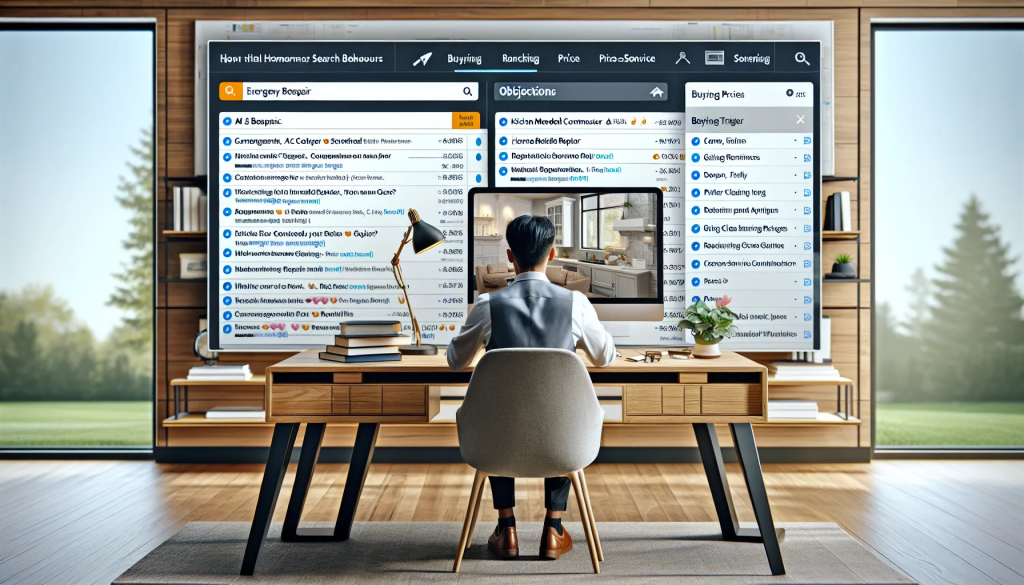
The same service page can’t speak the same way to a panicked homeowner with a burst pipe and a homeowner casually exploring solar.
We write differently when we know why they’re searching, what they’re worried about, and what makes them finally pick up the phone.
Identify Search Intent Behind Your Target Keywords
Before we write, we look at the core keywords for the page and ask, “What is this person really trying to do?” For example:
- “emergency AC repair [city]” → desperate, wants fast response and availability.
- “kitchen remodel contractor [city]” → researching, wants inspiration and proof.
- “gutter cleaning prices [city]” → price-sensitive, wants ballpark costs.
We then match the page angle to that intent, emergency pages stress speed and 24/7 help: project pages stress expertise, planning, and past results.
Profile The Ideal Homeowner And Their Situation
We don’t need a 10-page persona document, but we do need a clear picture:
- What type of home do they own (age, size, neighborhood)?
- Are they DIY-inclined or want full-service help?
- Are they worried about resale value, safety, comfort, or aesthetics?
- How much do disruptions matter (kids, pets, working from home)?
When we picture a real person, and maybe even a real client we’ve helped, our language naturally becomes clearer, more specific, and more persuasive.
Address Risks, Objections, And Price Sensitivity
Most homeowners are quietly thinking:
- “Am I going to get ripped off?”
- “Will they actually show up on time?”
- “What if something goes wrong later?”
Strong service pages don’t dodge these fears. We address them directly with:
- Clear explanations of pricing structure (even if we can’t give exact quotes).
- Guarantees and warranties spelled out in plain language.
- Straight talk about what’s included and what’s not.
By naming the risks and showing how we handle them, we build the kind of trust that makes price less of the only factor.
Structure Your Service Page For Skimmers And Serious Shoppers
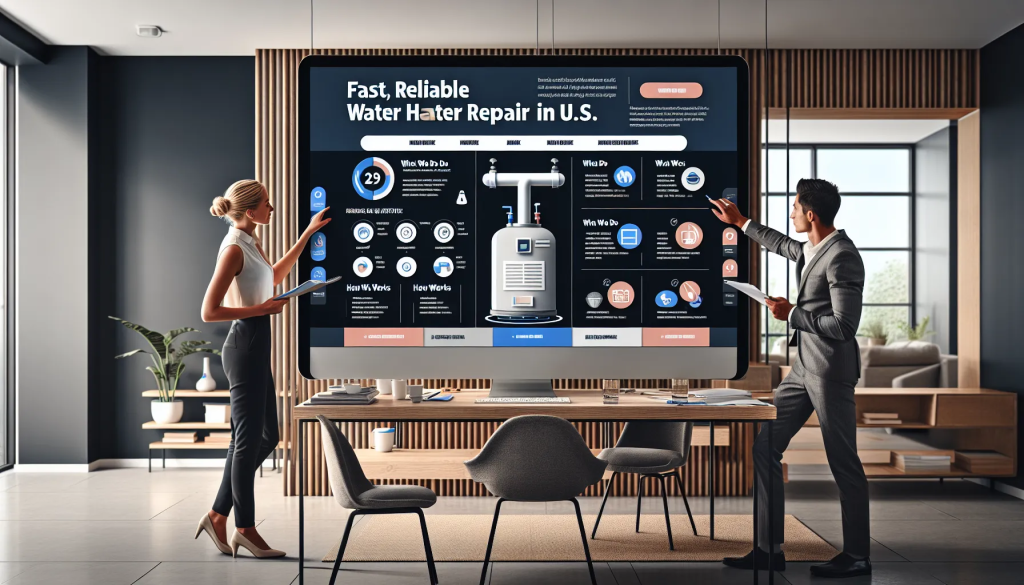
Most visitors skim first, then read deeply if they like what they see. Our structure needs to serve both.
We lead with clarity, then layer in details for homeowners who want to dig in.
Use A Clear, Benefit-Led Headline And Subheadline
The headline should answer, in one glance: “What do you do, for whom, and where?” For example:
Fast, Reliable Water Heater Repair in Denver, CO
Same-day service from licensed plumbers who respect your home and your time.
The subheadline lets us quickly add the main benefit or differentiator, speed, cleanliness, financing, warranties, or all of the above.
Open With A Short, Reassuring Overview Above The Fold
Above the fold (before scrolling), homeowners should see:
- What we do.
- Who we serve.
- Why we’re trustworthy.
- The primary call to action.
A short paragraph or bullet list can do this. Think of it as the 20-second version of your in-home pitch, calm, confident, and focused on the homeowner’s outcome.
Lay Out The Service, Process, And Options In Logical Order
Once we’ve hooked them, we walk them through:
- What we do – the specific problems we solve.
- How it works – the step-by-step process from first contact to follow-up.
- What they can choose – packages, tiers, repair vs. replace, etc.
This mirrors the way people mentally buy: “Is this the right solution? Can I handle the process? Which option is best for me?”
Make The Page Scannable With Sections, Bullets, And Visual Cues
Dense paragraphs lose homeowners on phones. We:
- Use clear section headings and subheadings.
- Break out key points into bullets.
- Use visual elements, icons, checklists, pull quotes, to highlight must-see details.
If someone can scan from top to bottom in 15 seconds and still grasp what we do, where we work, and how to contact us, the structure is working.
Craft Copy That Builds Trust And Sells The Service

With structure in place, we focus on the words themselves. Our copy should feel like a knowledgeable neighbor explaining options at the kitchen table.
Clear, specific language always beats clever slogans for service pages.
Write In Plain Language, Avoiding Jargon And Fluff
Most homeowners don’t speak in technical terms, and they don’t want to learn them in a panic.
We trade jargon like “diagnostic evaluation of HVAC system efficiency” for, “We inspect your system, find the problem, and explain your options in plain English before any work begins.”
We also cut filler. If a sentence doesn’t clarify, reassure, or move someone closer to taking action, it probably doesn’t belong on a service page.
Highlight Benefits, Not Just Features And Tasks
Features talk about what we do: benefits explain why it matters.
Instead of:
“We offer duct cleaning and filter replacements.”
We write:
“We clean your ducts and replace filters so your system runs more efficiently, your air is cleaner, and your home feels more comfortable year-round.”
Every list of tasks or services should tie back to outcomes homeowners care about: comfort, safety, savings, convenience, and peace of mind.
Use Localized, Trust-Building Details And Social Proof
Generic copy feels like it could belong to any contractor in any city.
We anchor our pages locally by mentioning:
- Neighborhoods, landmarks, or common home styles we work on.
- Specific local problems (frozen pipes, clay soil, storm damage patterns).
- Real customer names (with permission) and neighborhoods in testimonials.
Layer in certifications, years in business, and “X+ homes served in [city]” to give visitors a sense that “these are the people everyone here uses.”
Weave Calls To Action Throughout The Page
We don’t save the call to action for the bottom. We:
- Place a primary CTA button above the fold (call / schedule / estimate).
- Repeat a variation at the end of major sections.
- Use in-line prompts like, “Not sure what you need? Call us and we’ll talk you through it in 5 minutes.“
Each CTA should feel like a helpful next step, not pressure. The more natural it feels to take action, the better the page converts.
On-Page SEO Essentials For Local Service Pages

Strong copy is only half the equation. To write service pages that Google loves, we need to make it easy for search engines to understand what the page is about and who it serves.
SEO doesn’t mean stuffing keywords: it means strategic clarity.
Choose And Place Primary Keywords Strategically
We start with one primary keyword that fits our service and location, like:
- “roof repair [city]”
- “furnace installation [city]”
Then we support it with natural variations: “roof leak repair,” “emergency roof repair,” neighborhood names, and common problem phrases.
We work these into:
- The H1 and at least one subheading.
- The first 100–150 words.
- Image alt text and, when natural, in bullets.
If we can read the page out loud and it sounds human, we’re doing it right.
Optimize Titles, Meta Descriptions, And Headings
Our title tag should clearly state the service and location, and include a small benefit or brand element. For example:
Roof Repair in Denver, CO | Fast, Local Roofing Company
Our meta description should:
- Reinforce the service and location.
- Include a key benefit or differentiator.
- End with a soft call to action.
Headings (H1, H2, H3) should follow a logical outline and include keywords where they naturally fit, never at the cost of clarity.
Use Location Signals And Internal Links Effectively
To strengthen local relevance, we:
- Include our full NAP (name, address, phone) in the footer or a contact block.
- Mention primary service areas and key suburbs.
- Link internally to related services and location pages.
Internal links help both users and Google understand how our services connect, and keep homeowners exploring the site instead of bouncing back to search.
Improve Load Speed, Mobile Experience, And Accessibility
All the right keywords can’t rescue a slow, hard-to-use page. We make sure:
- Images are compressed and sized correctly.
- Buttons are big enough and easy to tap on mobile.
- Text has good contrast and font sizes are readable.
- Forms are simple and don’t require too many fields.
Fast, accessible pages keep visitors engaged longer, something both homeowners and Google reward.
Enhance Credibility With Proof, Media, And Helpful Extras
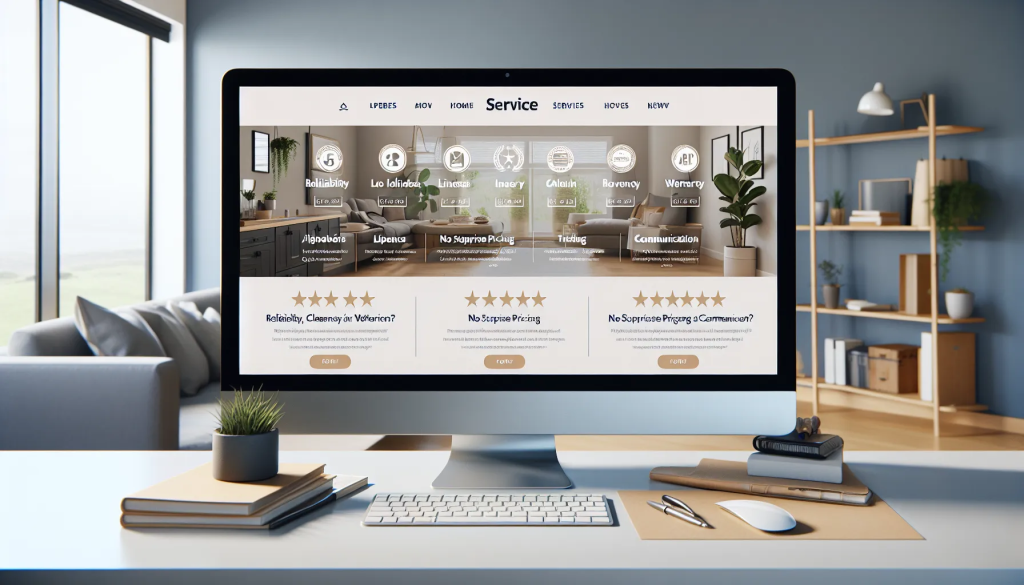
Once we’ve shown we understand the problem and have a clear solution, homeowners look for proof. They want to know, “Have you done this successfully for people like me?”
The right mix of social proof and helpful content turns a good service page into a great one.
Show Reviews, Guarantees, Certifications, And Before–Afters
We don’t hide our reviews on a separate page. We:
- Pull in selected 5-star reviews that speak to reliability, cleanliness, and communication.
- Clearly display guarantees (e.g., “No Surprise Pricing,” “We Leave Your Home Cleaner Than We Found It”).
- Highlight licenses, insurance, and certifications that matter in our trade.
- Use before-and-after photos so homeowners can literally see the difference.
This proof reassures people who’ve never worked with us that we’re a safe, professional choice.
Answer Key Pre-Sales Questions Without Creating Bloat
We want to be thorough without writing a wall of text.
A concise FAQ section can address:
- Typical project timelines.
- What homeowners need to do before we arrive.
- Payment options and financing.
- Warranty coverage and follow-up policies.
We focus on questions that actually affect the decision to call. If a detail won’t help someone decide, it probably belongs in a separate resource page or blog post, not the main service page.
Use Photos, Video, And Trust Badges The Right Way
Visuals can either strengthen trust or make a page feel cluttered.
We use:
- Real project photos instead of stock imagery whenever possible.
- Short explainer videos or quick walkthroughs from the owner or lead technician.
- Trust badges (BBB, industry associations, manufacturer certifications) placed near CTAs and in the footer.
We avoid auto-play video with sound, massive galleries that slow the page, and walls of badges that feel like noise. Every visual element should have a job: to clarify, reassure, or guide action.
Repeatable Workflow For Creating Or Improving Service Pages

Writing one strong service page is great: building a whole set for every service and location is where the real impact happens.
We use a simple workflow that makes the process repeatable instead of reinventing the wheel each time.
Audit Existing Service Pages Against A Simple Checklist
We start by reviewing each page and asking:
- Is there one clear service + location focus?
- Does the page answer the top homeowner questions?
- Are there strong CTAs and visible proof elements?
- Is the content unique, not copied across multiple locations?
A quick audit shows whether we should rewrite from scratch or improve what’s already there.
Draft, Edit, And Optimize In A Clear Step-By-Step Process
Our process usually looks like this:
- Outline sections based on homeowner questions and search intent.
- Draft copy without overthinking keywords.
- Edit for clarity, flow, and tone (read it out loud).
- Optimize titles, headings, and on-page SEO.
- Publish and double-check formatting on desktop and mobile.
Separating drafting from editing and SEO keeps the writing human and natural.
Measure Performance And Prioritize Ongoing Improvements
Once pages are live, we track:
- Organic traffic and rankings for target keywords.
- Calls, form fills, and chats generated from each page.
- Engagement metrics like time on page and bounce rate.
We then prioritize tweaks: improving CTAs, adding better proof, clarifying pricing, or speeding up load times. Service pages shouldn’t be “set and forget” assets, they’re living, revenue-generating parts of our business.
Conclusion
Writing service pages that Google and homeowners love isn’t about tricks or templates. It’s about understanding what people need in stressful, high-stakes home decisions and building pages that genuinely help them make a confident choice.
When we clarify the page’s job, write for real homeowners, and pair strong copy with smart SEO, our service pages stop being digital brochures and start acting like our best salesperson, working 24/7.
If we treat each service page as a focused, high-value conversation with one ideal homeowner in one specific location, the results tend to follow: better rankings, more calls, and higher-quality leads that already trust us before we ever step through the door.
Frequently Asked Questions
What is the main goal of a high-performing service page for local home services?
A high-performing service page has one clear job: attract the right local searchers, answer their key questions fast, and guide them to one primary action, usually calling now or requesting an estimate. It should feel like a helpful guide, not a generic online brochure.
How do I write service pages that Google and homeowners both love?
To write service pages that Google and homeowners love, focus each page on one service and location, match copy to search intent, answer common homeowner questions, use clear benefit-led headlines, weave in social proof, and optimize basics like titles, headings, internal links, and mobile experience without keyword stuffing.
How should I structure a local service page for skimmers and serious shoppers?
Start with a clear, benefit-focused headline and subheadline that state what you do, for whom, and where. Above the fold, include a brief overview and a primary CTA. Below, lay out services, process, options, proof, and FAQs in clear sections with bullets, visuals, and repeated, helpful calls to action.
What are best practices for on-page SEO on local service pages?
Choose one primary keyword such as “roof repair [city]” and add natural variations in the H1, subheadings, intro, and image alt text. Use a clear title tag and meta description, add NAP and service areas, link to related services, and ensure fast load speed, mobile usability, and accessibility.
How long should a home service page be for SEO and conversions?
There’s no fixed ideal word count, but most effective home service pages are typically 800–1,500 words. That length lets you cover problems, process, pricing expectations, proof, and FAQs without fluff. Prioritize clarity and usefulness; thin, 200-word pages rarely rank well or convert high-intent visitors.
Can I target multiple cities or services on one service page?
It’s better to create separate service pages for each primary service and core location. Combining “plumbing, heating, electrical in 5 cities” on one page dilutes relevance for both Google and homeowners. Use individual service + city pages, then support them with internal links and a broader service-area or locations overview page.